Combining Lab Data and Computational Modelling to Protect Pollinators
Published on Fri Jun 26 2026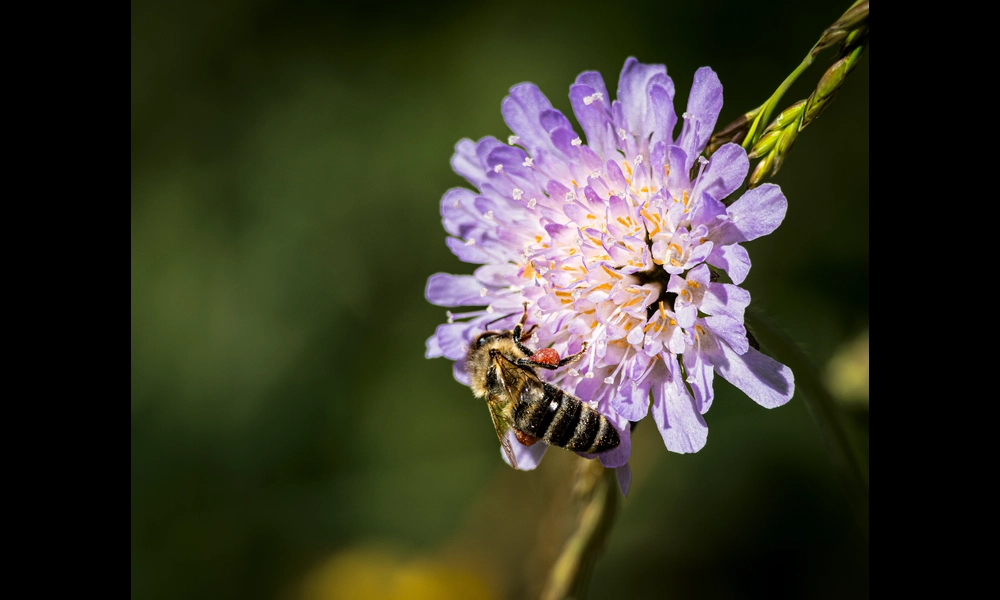 Hard working bee | Anna3_ on Flickr
Protecting pollinators from chemical hazards while maintaining agricultural productivity is a delicate balancing act. While current environmental risk assessments (ERA) use laboratory data to determine if pesticides are "safe," researchers are beginning to question whether these lab-based tests accurately reflect how pollinator populations behave in complex, real-world landscapes. A new study published as a preprint suggests that by combining two different types of computer modeling, scientists can better predict how insects might react to chemicals in the wild.
The researchers, led by Florian Schunck and colleagues from several European institutions, investigated whether it is possible to "translate" laboratory observations into large-scale landscape simulations. They focused on a solitary bee species, *Osmia bicornis*, and its exposure to a pesticide known as sulfoxaflor. Because the research was conducted using a computational model (a "simulation"), it serves as an exploratory look at how we might better manage environmental risks in the future.
To do this, the team integrated two specific systems: ALMaSS and BufferGUTS. For non-specialists, think of ALMaSS as a highly detailed "digital twin" of a landscape. It simulates not just the insects, but their movements, life cycles, and interactions with a farm’s changing environment—including soil, pollen, and nectar. The second component, BufferGUTS, is a "toxicokinetic-toxicodynamic" (TKTD) model. This essentially calculates how a chemical moves through an organism's body over time and the specific damage it causes to the individual.
By combining these two models, the researchers created a tool that could estimate risk for organisms with more precision than standard methods. Instead of just asking "Does this dose kill an adult bee today?" the integrated model can ask, "How does this dose affect the population’s ability to survive and reproduce over several years in a field with varying levels of pesticide exposure?"
The results of the simulation provided an interesting insight into why current assessments might occasionally undercount risks. In scenarios where only adult bees were exposed to high levels of sulfoxaflor, the pollinator populations remained remarkably stable even at 400 times the "acceptable" concentration. This suggests that as long as the adults survive to reproduce, the population can remain steady—even if many individuals are dying from acute exposure.
However, the researchers found a much different result when they included earlier life stages in the simulation. When the model accounted for potential mortality in eggs and larvae (the "pre-reproductive" stages), the pollin population saw significant declines of roughly 30% to 33%. The team suggests that because these young insects are stationary and have fewer ways to defend themselves or move away from chemicals, they may be far more vulnerable than adults.
The findings highlight a potential shift in how scientists think about pollinator safety. Currently, many regulatory frameworks rely heavily on adult mortality as the primary metric for risk. This study suggests that because some insects—particularly solitary bees—rely heavily on their offspring's survival to maintain numbers, focusing only on adult health might overlook significant risks to the overall population.
While this research is still in the preprint phase and has not been peer-reviewed, it offers a promising path for "systems-based" risk assessment. By moving toward these complex, multi-stage models, researchers may eventually be able to provide more nuanced data to help policymakers balance the needs of farmers with the vital role pollinators play in our ecosystem.
For those outside of academia, this research is important because it addresses the "why" behind pollinator decline. It suggests that the best way to protect species like the *Osmia bicornis* may involve looking beyond what happens to a bee while it's flying and considering the safety of its "hidden" life stages—the eggs and larvae—that are essential for the next generation.
Keep Reading


Q-Pilot: Revolutionizing Quantum Computing with Flying Ancillas and Field Programmable Qubit Arrays. A groundbreaking compiler that enhances efficiency and reduces errors in quantum circuits. #QuantumComputing #QubitArrays