New “Spline Clock” Model Designed to Capture the Varying Speed of Viral Mutations
Published on Fri Jun 26 2026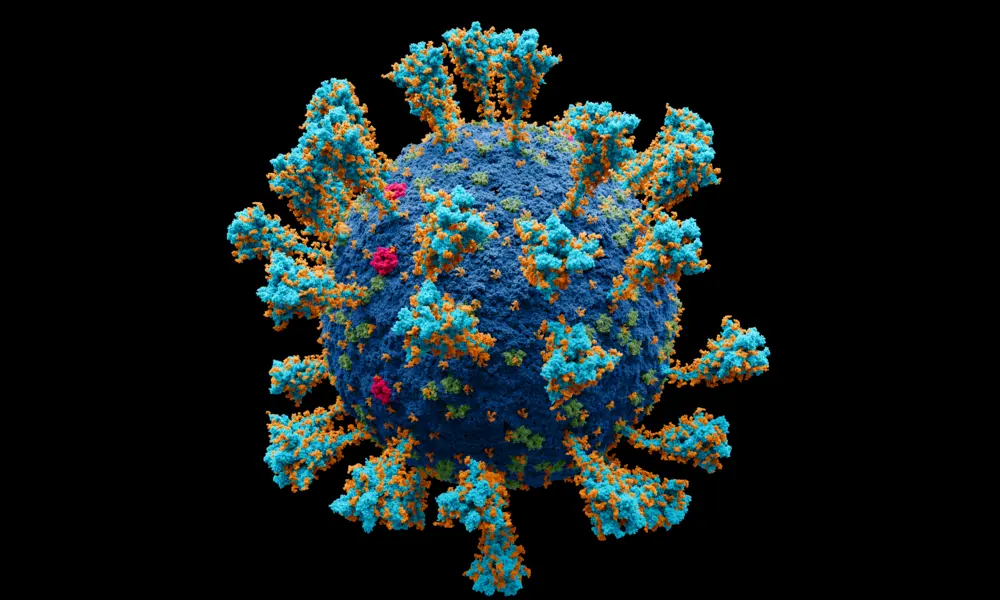 File:Coronavirus. SARS-CoV-2.png | Jul059 on Wikimedia
When scientists track how viruses evolve or how species diverge over millions of years, they generally rely on what is known as a "molecular clock." This concept assumes that mutations accumulate at a relatively steady rate over time, allowing researchers to work backward from current genetic data to determine when a specific mutation first appeared or how quickly a virus is spreading. However, nature is rarely constant. Environmental shifts, host defenses, and other biological factors can cause the "ticking" of this clock to speed up or slow down unexpectedly.
A new preprint study suggests a more flexible mathematical approach to account for these fluctuations. Researchers from UCLA and KU Leuven have developed what they call a "spline clock model." This method is designed to better capture the reality of time-varying evolutionary rates, particularly in fast-moving pathogens like RNA viruses or in long-term evolutionary histories where environmental pressures change over millennia.
The challenge for scientists lies in the math: if the rate of mutation changes at every moment, calculating the probability of a specific genetic sequence is computationally exhausting. Previous models have tried to simplify this by breaking time into "epochs" (blocks of constant rates) or using simple mathematical curves. However, these methods can sometimes produce jagged results or fail to capture complex, nuanced transitions in evolutionary speed.
The authors’ new model uses "B-splines"—a type of mathematical basis that allows for the creation of smooth, continuous curves—to represent the evolution rate. By applying this to inhomogeneous continuous-time Markov chains (mathematical models used to describe how characteristics change over time), the researchers created a way to model rates that vary smoothly rather than in fits and starts. To ensure the results remained practical for large datasets, they utilized a technique called Gauss-Legendre quadrature, which allows computers to approximate complex integrals quickly and accurately.
The effectiveness of this new method was first tested in a simulation study. The researchers created "synthetic" genetic data where they already knew the true, fluctuating rates of evolution. When they compared several different models, the spline clock model was able to recover those original rates more accurately than competing methods. Crucially, it did so with narrower "credible intervals," meaning the model was not only more accurate but also more certain of its results.
The researchers then applied the model to two very different real-world cases to see if it could handle "messy" biological data. The first was the foamy virus (FV), a group of retroviruses with a long, stable history involving millions of years of evolution. By applying the spline clock, the team observed significant shifts in mutation rates over vast periods of time—variations of up to four orders of magnitude. This suggests that the historical trajectory of the virus was far more dynamic than simpler models might imply.
The second application was much more contemporary: tracking the spread of SARS-CoV-2 across Europe in 2020. In this context, the "evolutionary rate" wasn't just about genetic mutations; it was a measure of "spatial diffusion"—the speed at which the virus moved between different countries. The study found that the spline clock model could accurately track how the speed of transmission dropped during periods of strict lockdown and surged when measures were relaxed.
While this research is still in the preprint stage and has not yet been peer-reviewed, it offers a potential new tool for both evolutionary biologists and epidemiologists. By providing a way to model "smooth" transitions in time, the spline clock could help scientists better understand how long-term environmental changes affect ancient lineages and how modern public health policies impact the immediate spread of infectious diseases.
For those outside of academia, this research highlights an important step in making biological models more realistic. Rather than forcing nature into simple boxes—like a constant rate or a predictable decay—the use of splines allows scientists to let the data "speak" for itself, potentially leading to clearer maps of how diseases move through populations and how life evolves over millions of years.