Fluorinated Monolayers for Improved Stability in Inverted Perovskite Solar Cells
Published on Fri Jun 26 2026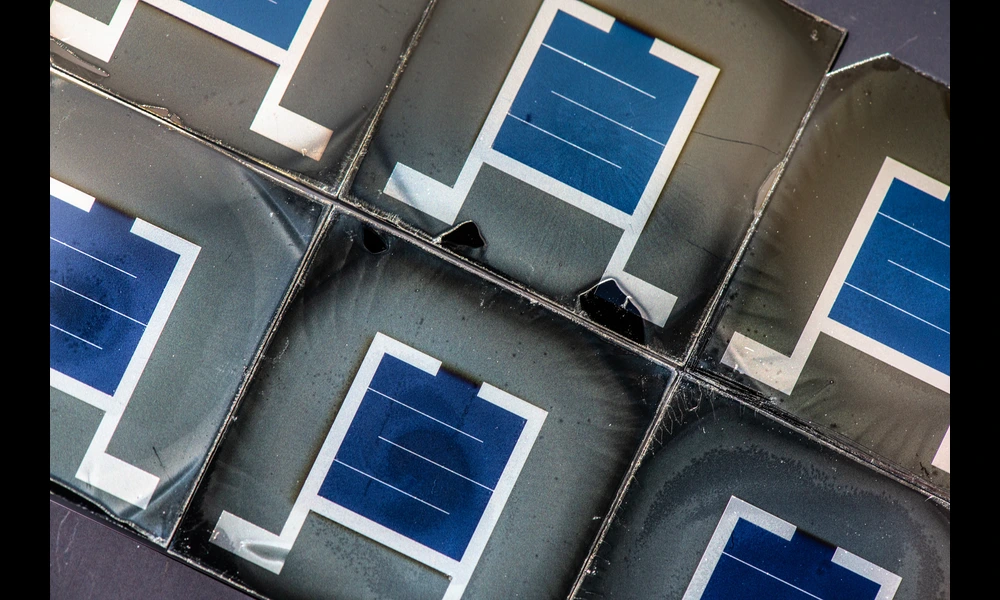 298 060 002 | U.S. Department of Energy on Flickr
A team of researchers released a preprint paper detailing a new method for enhancing the stability and efficiency of perovskite solar cells. By integrating fluorinated self-assembling monolayers (SAMs) on both interfaces of perovskite solar cells, they've achieved a notable increase in stability and performance. This innovation not only pushes the boundaries of solar cell technology but also opens doors for more sustainable and long-lasting solar energy solutions.
Perovskite solar cells (PSCs) are known for their potential to revolutionize solar energy due to their unique semiconductor properties and cost-effective manufacturing methods. However, their efficiency is often marred by structural defects that lead to performance instability, particularly at the interfaces where electricity is collected. The authors propose a solution through the novel use of self-assembling monolayers made from 5-(4-[bis(4-fluorophenyl)amino]phenyl)thiophene-2-carboxylic acid (FTPATC). This innovation addresses critical defects by improving the energy alignment at the charge-collection junctions, thereby boosting the life span and effectiveness of PSCs.
The integration of FTPATC as a fluorinated SAM has resulted in a significant enhancement in device efficiency, reaching up to 22.2%, and maintaining 88% performance stability over 1,680 hours under continuous light, a simulation of real-world conditions. This advancement is attributed to the SAMs' role in reducing ionic cluster accumulation and electrochemical corrosion, two major factors that degrade solar cell efficiency. Furthermore, the dual-side passivation mimics the robust properties found in more established silicon-based technologies, offering a promising leap forward in the longevity and practical application of perovskites.
An important aspect of this research is how it tackles the electrochemical corrosion and non-radiative recombination that traditionally plague PSCs. The SAMs achieve this by reducing potential barriers and stress within the lattice structure of the perovskite absorber. Additionally, these modifications help in aligning energy levels more precisely between the SAM and the perovskite, which crucially enhances the flow and collection of electric charge.
For the average reader, this research could denote a significant step towards more efficient and durable solar panels, potentially lowering energy costs and environmental impact. With the continuous demand for more sustainable energy solutions, the implications of more stable and cost-effective solar technology extend beyond homes and businesses to broader applications in industries and public infrastructure.
In conclusion, this pioneering research advances the frontier of solar technology by effectively addressing long-standing issues of instability and efficiency in perovskite solar cells. This could be a pivotal moment in harnessing solar energy more effectively, leading to greater adoption and reliance on renewable energy sources worldwide. As the technology improves and scales, it promises to bring cleaner, more efficient energy to all corners of the globe.