New Statistical Framework for Predicting Extreme Events
Published on Thu Jul 02 2026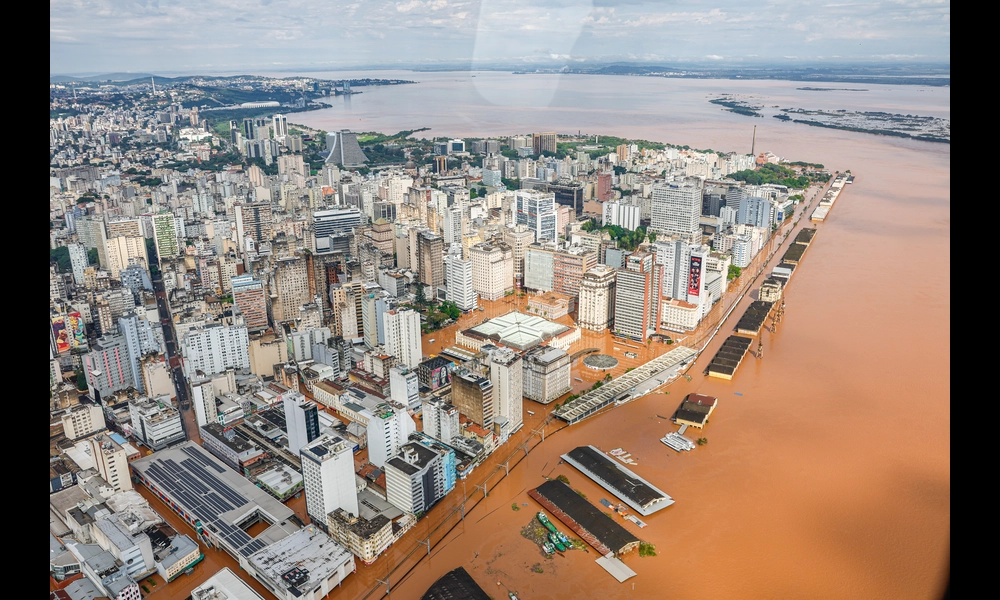 File:05.05.2024 - Sobrevoo das áreas afetadas pelas chuvas em Canoas - 53700500641.jpg | Chronus on Wikimedia
Extreme Events are exceedingly rare but often significant occurrences. Consider massive floods, extreme solar flares, or sudden financial crashes. These events can have massive impacts and accurately predicting them could save lives and provide immense value to society. It can be extremely challenging to predict extreme events and oftentimes our understanding is limited. Because they're so rare, there's very little data to study and enable accurate modelling and forecasting. Additionally, the sheer volume of "normal" days make it difficult for models to distinguish between looming disasters and ordinary fluctuations. In a recent preprint study, researchers Benjamin Bobbia and Stilian Stoev proposed a new mathematical framework for predicting extreme events even with limited input data. Their research could help improve our understanding of these phenomenon or even improve early warning systems.
Instead of trying to build a complete model that encompasses all the nuances of the complex systems that produce these extreme events, the researchers outlined a technique that focuses only on the extreme events. Their technique combines many imperfect indicators into a single predictor function. The researchers then optimized this function for "tail dependence" with the extreme events. Tail dependence measures how strongly correlated the extreme deviations are for two variables, even if they're otherwise not coordinated. For example, a river can support recreational boats and commercial ships. normally the varying levels of traffic for these vessels have little to no correlation, however in an extreme event scenario (drought, flood, hurricane, dam breach, etc.) both may see dramatically increased or decreased traffic. This is important because a model that works well for a system in normal times may struggle with the altered dynamics that come with an extreme event scenario.
The researchers tested their framework by comparing the predictors it generated to those leveraging "oracle estimators" with a complete understanding of systems producing the extreme events. They found that their predictors performed well in a wide variety of scenarios. For a real-world data test, they created a predictor for "X-class" solar flares. These powerful bursts of radiation from the sun can damage satellites in space and disrupt electrical and communications systems on earth. They found that their predictor achieved state-of-the-art results without relying on manual tuning. While the researchers appear to have successfully tested their technique, they recognize its limitations and state that there are cases where it does not produce an optimal predictor.
This research is not yet peer-reviewed, but it's easy to imagine the possible implications. Analyzing how different variables factor into optimal predictors could result in a better understanding of extreme events, their causes, mechanics, and effects. There's also the obvious applications towards early-warning systems which could have massive implications and benefits to society in a wide variety of fields. The researchers have also released an interactive application using the Shiny framework in R. This enables other researchers to see how well the technique performs when applied to different scenarios.